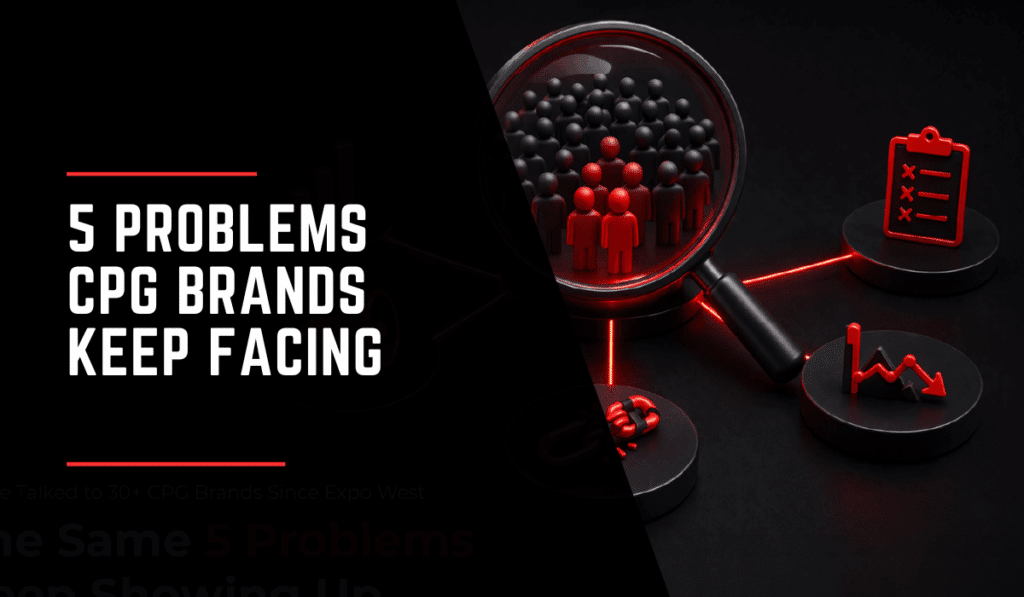
Expo West is the one week a year where the entire natural products industry is in the same building. Founders, operators, buyers, investors, agencies, distributors. Everyone’s there. Everyone’s talking. And if you’re paying attention, you start to hear the same things over and over again.
We interacted with 150+ brands at our booth and hosted 450+ CPG operators at our dinner at Morton’s steakhouse that week. In the month since, we’ve been in discovery conversations with dozens of those brands. Different categories. Different stages. Different revenue. But the same five problems kept surfacing in many of these conversations.
This isn’t a trends report. This is what’s actually happening on the ground in CPG right now.
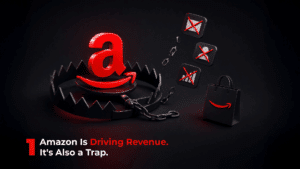
1. Amazon Is Driving Revenue. It’s Also a Trap.
This was the most common conversation by far.
Brand after brand told us some version of the same story: Amazon accounts for the majority of their online revenue, sometimes north of 90%. It’s working. Sales are growing. The ads are profitable. So what’s the problem?
The problem is they don’t own any of it.
No customer email addresses. No first-party data. No ability to build a relationship beyond the transaction. Amazon owns the customer. The brand just fulfills the order.
One brand we spoke to is doing $1.5 million a year on Amazon and has never captured a single email from a customer who bought their product. Think about that. A million and a half in revenue and they couldn’t send a single follow-up if Amazon changed the rules tomorrow.
The brands that are ahead of this aren’t abandoning Amazon. They’re using it as a revenue engine while building something they actually own in the background. A Shopify site. An email list. A content library. A direct relationship with the person buying their product.
The ones that aren’t thinking about this yet? They’re one algorithm change away from a very bad quarter.
2. Product Quality Is Outpacing Content Quality by a Mile.
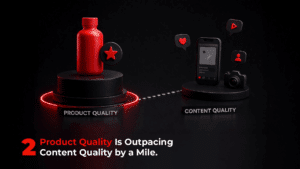
This one surprised us, not because it exists, but because of how wide the gap is.
We talked to a brand with 145 SKUs on shelves at Walmart, Target, and CVS. Their product photography looked like it was shot in 2016 on a folding table. Over-edited. Flat. No lifestyle context. No human element. The kind of imagery that makes a shopper scroll right past it.
We talked to another brand with an incredible product and a passionate founder who hadn’t posted on Instagram in almost a year. Not because they didn’t care. Because nobody was doing it.
And then there was the founder who has 700 YouTube videos, almost 1,000 Instagram posts, and a TikTok account with under 700 followers. Massive effort. Almost no return.
The content gap in CPG right now isn’t about effort. It’s about strategy. Brands are either not producing content at all, or they’re producing a ton of it with no distribution plan, no creative strategy, and no understanding of what actually converts versus what just fills a feed.
The fix isn’t “post more.” The fix is building a content engine that connects production to distribution to performance. Most brands don’t have that system, and it shows.
3. Everyone Wants to “Do Marketing.” Nobody Knows What to Do First.
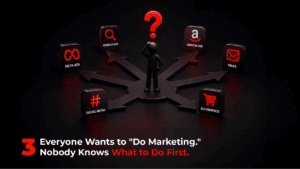
Channel paralysis is real.
One founder we talked to spends $120,000 a month on Meta ads. Nothing on Google. Nothing on Amazon ads. Nothing on email. One channel, all the eggs, and a vague sense that the ceiling is getting closer.
Another brand wants to launch paid media, build a new website, start posting on social, and expand to Amazon all at the same time. They have budget. They have ambition. They have zero framework for sequencing any of it.
The question we heard the most wasn’t “should we invest in digital?” That debate is over. The question was “what do we turn on first, and how do we avoid spreading too thin?”
The answer is different for every brand, but the principle is the same: pick the channel that compounds the fastest, get it working, then layer. Not everything at once. Not whatever your competitor is doing. The thing that moves your specific needle, right now, with the resources you actually have.
Most brands skip this step. They either go all in on one thing and never diversify, or they try everything simultaneously and wonder why nothing is working.
4. The Trust Problem Is Bigger Than the Budget Problem.

This was the one that came up more than any other, and it’s the one nobody in the agency world wants to talk about.
A founder told us he fired his last agency after 45 days. They charged him $4,000 a month, never built a single piece of creative, never tested more than two ad hooks, and never once flagged that his website had conversion issues that were killing performance before a dollar of ad spend even had a chance. He’s back to doing everything himself.
Another founder edits his own ads in CapCut every Sunday night, launches new creative every Monday, and manages his own Amazon PPC. He’s spending six figures a month and won’t hand any of it off because he’s never met an agency he trusted enough.
Another hasn’t posted on social media in a year because the last person they hired to manage it produced content that didn’t look or sound anything like the brand.
These aren’t founders with small budgets who can’t afford help. These are operators who’ve been burned and decided it’s safer to do it themselves. They’re stretched to the breaking point, and they know it. But the alternative, trusting someone else with the thing they built, feels riskier than exhaustion.
This is the real barrier to growth for a huge portion of CPG brands right now. It’s not budget. It’s trust. And rebuilding it requires something most agencies aren’t willing to do: show up with a genuine point of view, be honest about what you can and can’t do, and earn the relationship before you pitch the retainer.
5. Generalist Agencies Are Failing CPG Brands.
A supplement brand is spending $120K a month on Meta and their entire website is loaded with language that could get their ad account shut down overnight under Meta’s 2026 policy updates. Their current agency never flagged it.
Another supplement brand launched on Amazon with 55 orders and zero reviews. They tried Vine. It didn’t work. Their agency had no backup plan.
A brand with products in Costco is dealing with tariff exposure on imported ingredients that directly impacts their margins. Their marketing agency has never once asked about it.
These aren’t edge cases. These are the actual conversations we’re having. And in every single one, the brand had either worked with a generalist agency that missed these things entirely, or they’d never worked with an agency at all because they assumed no one would understand their category.
CPG is a different animal. Compliance rules vary by ingredient and platform. Amazon is its own ecosystem with its own playbook. Content needs are different than SaaS or ecommerce. Retail relationships add a layer of complexity that most digital agencies have never touched.
The brands winning right now aren’t just “doing digital.” They’re working with teams that already understand the landscape they operate in.
The Bigger Picture
Step back from the individual problems and a larger story emerges.
The CPG industry is in the middle of a structural shift. Brands that grew up on Amazon are realizing they built their house on rented land. Brands that grew up in retail are realizing they missed the digital window entirely. Both groups are recalibrating right now, just for different reasons.
The playbook that got most brands to where they are today is not the playbook that gets them to the next stage. Expo West made that clear. The energy in the building was incredible. The ambition was real. But so was the uncertainty.
The brands that come out of this transition stronger will be the ones that do three things: own their customer relationship instead of renting it, build a content system instead of posting and praying, and work with people who actually understand the category instead of settling for whoever picks up the phone.
Everything else is noise.